100 Years Ago in Aviation: The Birth of the Zeppelin
|
On the shores of Lake Constance, the first timbers were being laid for a 500 foot long floating wooden shed. It was an inauspicious start of a forty year dream of flight -- one that would circumnavigate the globe, explore both poles, deliver the mail, fight in wartime, and carry passengers in peace.
The year was 1898, and in nearby Manzell, one of the two partners in the venture stood on the porch of his family estate. Half of the funds for the venture, 400,000 marks of his personal fortune, were wrapped up in this dream with partner and aluminum maker Carl Berg. Although it was an equal partnership, one of the two men would become synonymous with Germany, flight and aviation history. He was a determined man and a visionary, almost 70 years old. His name was Count Ferdinand von Zeppelin.
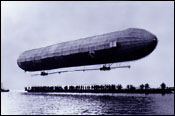
Two years later, on July 2, 1900, his first airship, the LZ 1, would take flight over the lake. The wooden shed, with his airship inside, was towed out into Lake Constance in the Bay of Manzell. It was a particularly calm morning and the airship was launched into the air after much careful preparation. The 416 foot long aluminum and cloth craft lifted off and slowly turned, hovering for thousands to see. Filled with hydrogen, it was a rigid, lighter than air ship. It slowly rose and maneuvered up and down, and left and right. Even if control was awkward and the craft lacked the power to perform in almost anything but smooth, calm air, it was a staggering success.
Despite early flights with LZ-1, it would be almost ten years and numerous failures and crashes before the Count would finally have his first buyer lined up -- the German military. All he had to do was to fly his fourth airship, LZ-4, from the lake to Mainz on a 24-hour endurance test.
At first, everything went well, and the airship soared over the German countryside. Citizens below cheered and river boats on the Rhine blew their horns in a salute. The entire nation was caught up in the Count's dream. And it had been a hard road: dozens of partners behind him, his fortune exhausted, his wife's family home in Latvia mortgaged for the last time, this would be his final attempt. If he was successful, he would be vindicated. If he failed, he would die an impoverished, broken old man.
Despite excellent progress early on in the trip, when the airship was nearing Mainz one of its engines started to act up. Ever cautious, the Count ordered a landing on the Rhine not far from the town of Oppenheim. With a huge crowd gathered along river banks, his crew made a few repairs to the engine and took back off.
As he passed Mannheim in the middle of the night, after 1 am, one of the airship's engines broke down completely. He forged ahead as the wind picked up, fighting for every mile. Finally, he landed near the village of Echterdingen in a farmer's field, not far from the Daimler engine works at Stuttgart. If their technicians could fix the motors, he would be able to make Mainz with ease.
It was not to be. As the crews worked on the engines, a sudden summer storm hit. Powerful wind gusts lashed the LZ-4 and shook the craft. A gust broke the airship from its moorings and the airship careened across the field. It struck a tree, igniting the ship's hydrogen. In a massive fireball, the LZ-4 burned to the ground. As quickly as the storm had hit, it ended.
Returning to the field from a local inn, Zeppelin surveyed the wreckage. Everything was lost. The crowd, out of respect for the old man, stood silently with their hats off. The Count stood speechless and stared at the disaster. Finally, he turned and walked away -- without saying a word. It was the end.
His dream shattered and his fortune exhausted, the Count returned home by train. His airships were done. He could never afford another to build another and without the patronage of the German military, his airship company would be forced into bankruptcy.
The German people, however, had other ideas. His dream had become their own. The proud spectacle of his airship flying over the Rhine River had ignited the spirit of a nation. Within days, contributions started to pour in. Children sent their personal savings, social clubs sent their membership dues, and numerous businessmen simply sent him money -- all simply donations -- begging that he try again.
The "miracle at Echterdingen," gave him the financing he needed to found the Luftshiffbau Zeppelin GmbH, a company that exists to this day. More importantly, he also founded Maybach Motorenbau, a subsidiary that would build the first engines with enough reliability to power his craft safely. The German military also purchased two of his Zeppelins, the first of many more to come, seizing the opportunity to cater to public will and further their goals.
From the ashes of the LZ-4, Count Zeppelin's airships would symbolize a generation of both glory and tragedy. Thousands would fly from Europe to North and South America in the highest style. Scheduled air mail service via Zeppelin would link the continents. And the military would have an observation and bombing platform that would revolutionize warfare. Over 160 airships were eventually built by the Zeppelin Company, including several for the United States Navy.
Ultimately, however, just one would be remembered by the American public: the Hindenburg. But that is another story....
BACK +
|

